
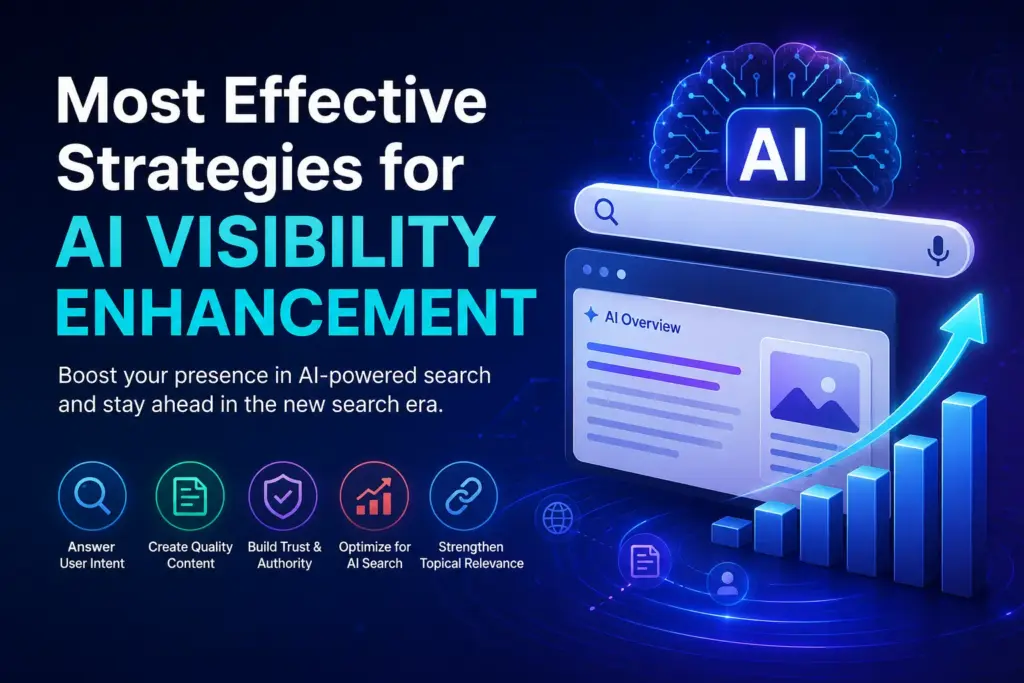
Most Effective Strategies for AI Visibility Enhancement A Complete Guide
AI is changing how people search online. Understanding the most effective strategies for AI visibility enhancement is now essential for businesses, marketers, and content creators who want to stay visible in AI-powered search. Instead of clicking through multiple websites, many users now get instant answers from Google AI Overviews, ChatGPT, Perplexity, and other AI search tools.
Google AI Overviews generate summaries by combining information from trusted web pages. This shift is changing how people discover content and how websites earn visibility. As AI search continues to grow, ranking on Google alone is no longer enough. Your content also needs to be easy for AI systems to understand, trust, and reference.
This is where Generative Engine Optimization (GEO) and Answer Engine Optimization (AEO) become important. They focus on creating clear, accurate, and well-structured content that directly answers user questions while providing complete and reliable information.
In this guide, you will learn the most effective strategies for AI visibility enhancement, how AI search evaluates content, and the practical steps you can take to improve your chances of appearing in AI-generated answers while continuing to grow your organic traffic.
What Is AI Visibility Enhancement?
The most effective strategies for AI visibility enhancement are often grouped under Generative Engine Optimization (GEO). GEO focuses on making content easier for AI systems to understand, trust, and reference. Common strategies include using schema markup, writing clear answers, building topical authority, and publishing trustworthy content.
However, success is not just about answering questions. Your content should also fill information gaps and fully satisfy user intent. AI systems prefer content that is clear, accurate, and easy to understand. They also look for well-organized pages with helpful headings and reliable information.
When your content answers both the main question and related follow-up questions, it becomes more valuable to readers and AI search tools. This can increase your chances of being cited in AI-generated answers and improve your overall search visibility.
Understanding the AI Overview Shift
The rise of Google AI Overviews marks an important change in modern search. In the past, users usually clicked through several search results to find answers. Today, Google may generate a summary that brings together information from multiple trusted websites.
When Google believes an AI-generated summary will help users, it may display an AI Overview near the top of the search results. Users can often find the answer without visiting a website, a behavior commonly known as a zero-click search.
However, some people think that appearing in an AI Overview is the only goal. That is not true, Google AI Overviews study found that the clicks lost were not low-quality clicks. Appearing in AI Overviews is valuable. However, your content should give users a reason to click and learn more.
This does not replace traditional SEO, but it changes how content is evaluated. Pages that clearly answer questions, demonstrate expertise, and provide reliable information have a better chance of being considered. A strong Organic Search engine optimization service can help optimize your website for both traditional search results and AI-powered search experiences.
Website owners should also remember that AI Overviews are designed to help users quickly understand a topic, not replace quality websites. As search continues to evolve, creating valuable content that satisfies user intent remains one of the strongest ways to stay visible.

How AI Search Is Changing SEO
For many years, SEO focused on keywords, long-form content, and backlinks to improve search rankings. These were the main factors that helped websites rank higher in search results.
Today, search is changing. AI-powered search tools do more than match keywords. Understanding the most effective strategies for AI visibility enhancement is becoming essential for businesses and content creators who want to stay visible in AI-powered search results.
Platforms like ChatGPT, Perplexity, Google AI Overviews, and other AI search tools read your content to understand the topic, context, and relationships between ideas. They look for content that is clear, accurate, well-structured, and helpful. For example, if someone searches “how to optimize for AI search,” AI systems compare information from many trusted websites.
They usually select pages that answer the question directly, use clear headings, and explain the topic in a simple way. If your content is confusing, outdated, or filled with unnecessary marketing language, AI may ignore it and choose another source instead. This is why Answer Engine Optimization (AEO) is becoming more important. AEO focuses on creating content that answers questions clearly so AI systems can easily understand, summarize, and reference it.
Traditional SEO still matters. Keywords, backlinks, and technical SEO continue to play an important role. However, combining strong SEO with helpful, well-structured content gives your website a better chance of appearing in both traditional search results and AI-generated answers.
How to Improve Visibility in Google AI Overviews
Improving visibility in Google AI Overviews requires more than adding keywords. The goal is to make your content easy for both users and AI systems to understand. This is where Answer Engine Optimization (AEO) becomes important. It helps structure content so AI systems can understand and present it more effectively. Here are some of the most effective strategies for AI Visibility enhancement.
Use Reliable Sources
Support your content with trustworthy sources, research, and official documentation whenever possible. Reliable information helps build trust with readers and increases your content’s credibility.
Match Search Intent
Understand why users are searching for a topic before creating content. Some users want a quick answer, while others need a detailed guide. Matching search intent helps create more useful content.
Add Structured Data
Use schema markup, such as FAQ, Article, or How-To schema, to help search engines understand your content better. While schema does not guarantee AI visibility, it provides additional context.
Strengthen Internal Linking
Link to related articles on your website to help users explore a topic in more depth. Internal links also help search engines understand the relationship between your pages.
Update Existing Content
Review your articles regularly and update outdated information, broken links, and statistics. Fresh content is more useful for readers and can remain relevant over time.
Write in Natural Language
Avoid keyword stuffing and complicated sentences. Write the way people naturally ask and answer questions. This makes your content easier for both readers and AI systems to understand.
Cover the Topic Completely
Answer the main question and include related subtopics, examples, and follow-up questions. Comprehensive content reduces the need for users to search elsewhere.
Build Brand Authority
Publish original research, case studies, or expert insights that demonstrate your knowledge. A trusted brand is more likely to be recognized as a reliable source.
Focus on Content Freshness
AI search prefers information that is accurate and up to date, especially for topics that change frequently. Regular updates keep your content useful and trustworthy.
Monitor Performance
Track impressions, clicks, user engagement, and search performance using tools like Google Search Console and Google Analytics. Use the data to improve your content over time.

Why Is AI Overview Not Available for Some Searches?
Google does not display AI Overviews for every search because not every query benefits from an AI-generated summary. Some searches have unclear intent, while others involve topics where accuracy is especially important.
Google also evaluates whether it has enough reliable information to create a confident response. If trusted sources are limited or the available information is inconsistent, an AI Overview may not appear. Availability can also vary by language, region, and feature rollout as Google continues improving the experience.
In many situations, traditional search results remain the better option because they allow users to compare different viewpoints directly. Understanding these limitations helps content creators focus on quality instead of expecting AI Overviews for every topic.
Conclusion
AI-powered search is changing how people find information online. To stay visible, create content that is helpful, trustworthy, and easy to read. The most effective strategies for AI visibility enhancement focus on quality, not shortcuts. Answer user questions in a clear way. Use simple headings and keep your content accurate. Share useful information to build trust in your niche.
No website can guarantee a place in Google AI Overviews. However, following these best practices can improve your chances of being featured. AI search will continue to change. Keep creating helpful content and focus on your readers. This can improve your long-term visibility and organic traffic.
Frequently Asked Questions
1. What are Google AI Overviews?
Google AI Overviews are AI-generated summaries that combine information from trusted sources to answer search queries quickly.
2. Is appearing in Google AI Overviews enough for SEO?
No. While appearing in AI Overviews increases visibility, your content should also provide extra value that encourages users to visit your website.
3. Do keywords still matter for AI Overviews?
Yes. Use keywords naturally while focusing on creating content that answers user questions clearly.
4. How can I make my content easier for AI to understand?
Use clear headings, short paragraphs, direct answers, and logical content organization.
5. Why are AI Overviews missing for some searches?
Google may not show them when reliable information is limited, the query is unclear, or traditional results are more useful.
6. Is technical SEO still important for AI Overview?
Yes. Fast loading speeds, mobile optimization, and crawlable pages continue to support overall search visibility.
7. How to structure content for Google AI Overviews?
Use clear headings, short paragraphs, direct answers, and helpful FAQs. Keep your content accurate, well-organized, and easy for both readers and AI to understand.